Your Regular at the Corner Table: NYC's Beloved Third Places and Why We Need Them More Than Ever
There's a woman named Gloria who has sat at the same window table at a small coffee shop in Bed-Stuy every Tuesday and Thursday morning for the better part of three years. She orders a large coffee with oat milk, she brings a canvas tote full of papers to grade (she teaches middle school English two neighborhoods over), and by now the staff doesn't even ask for her order. They just start making it when they see her come through the door.
"I have a perfectly good kitchen table at home," she says, smiling. "But it's not the same. Here, I'm part of something. People know me. I know them. It sounds simple, but when you live alone in this city, that kind of thing matters more than you'd think."
What Gloria has found, without necessarily having a name for it, is a third place. And if you've ever had a go-to spot that wasn't home and wasn't work — a diner booth that felt like yours, a barbershop where you stayed longer than the haircut required, a library corner you'd get a little territorial about — you know exactly what she means.
The Concept That's Older Than the Problem
Sociologist Ray Oldenburg coined the term "third place" back in the 1980s, describing it as the informal public space that anchors community life beyond the domestic and professional realms. Oldenburg was talking about places like the neighborhood tavern, the barbershop, the town square — spots defined not by what they sell, but by who keeps coming back and why.
For a while, the concept felt almost nostalgic, a description of something that used to exist before chain coffee shops replaced corner diners and everyone started working from home with their earbuds in. But something interesting is happening in New York right now. Third places aren't disappearing — they're getting rediscovered, and in some cases, they're being intentionally rebuilt.
"I think people are hungry for it in a way they maybe weren't ten years ago," says urban sociologist Dr. James Whitfield, who studies social connection in dense cities. "The pandemic accelerated a lot of isolation that was already quietly building. People are now more aware of what they're missing, and they're more deliberate about seeking it out."
The Barbershop That Runs on Conversation
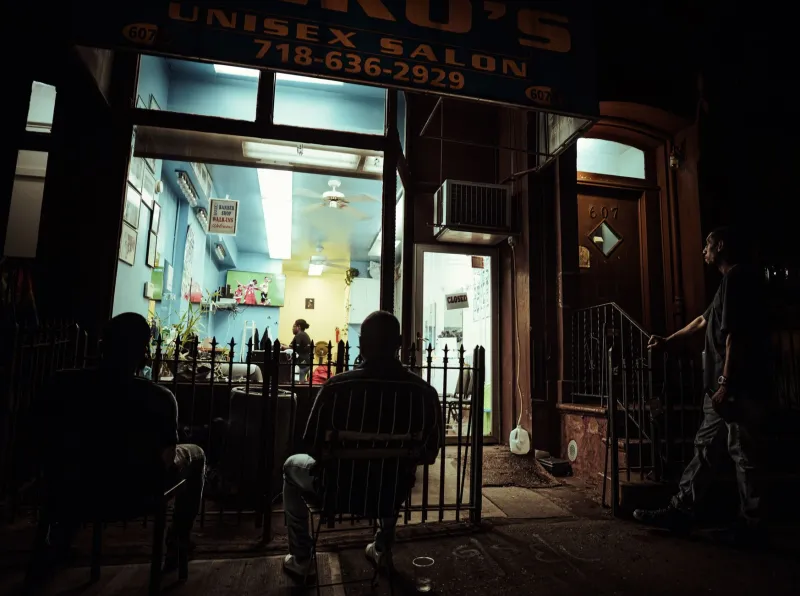
Step into Marcus's barbershop on a Saturday afternoon in Crown Heights and you'll understand immediately why some of his clients have been coming for a decade. The haircuts are good, yes. But the room does something else entirely.
There are four chairs, a rotating cast of regulars, and a conversational atmosphere that manages to be both completely unpredictable and deeply familiar. Sports, local politics, someone's kid's school situation, a debate about a restaurant that just opened — the topics move fast and the opinions are never in short supply. Marcus himself holds court from his station near the window, laughing easily, redirecting when things get too heated, remembering details about people's lives that they shared months ago.
"This is the one place I come where I don't have to explain myself," says one regular, a construction foreman named Dwayne who's been coming since the shop opened. "Everyone here already knows the context. You walk in and you're just... part of it."
That sense of existing context — of not having to start from scratch every time — is one of the defining features of a real third place. It's what separates a good spot from a great one.
Libraries: The Underrated Third Place
If barbershops are the third places people romanticize, libraries are the ones they underestimate. But ask around, and you'll find New Yorkers who treat their branch library the way other people treat their favorite bar — as a place they belong, with people they know, in a room that feels like theirs.
The New York Public Library system has, in recent years, leaned into this identity. More branches are hosting community events, creating dedicated reading and gathering spaces, and simply making it easier for people to linger. The result is that some branches have developed their own distinct social ecosystems — regulars who greet each other, staff who remember preferences, a rhythm to the week that feels almost familial.
In Inwood, a retired postal worker named Arthur has spent his weekday mornings at the local branch for two years. He reads the newspaper, works on a memoir he may or may not ever finish, and chats with the librarians and the other regulars who drift in around the same time each day. "I'm not lonely," he's quick to clarify. "I have family, I have friends. But this is different. This is my spot. My people, in a way."
What Makes a Third Place Actually Work
Not every cafe or community room earns the title. Third places have some consistent qualities that distinguish them from just being a place you go.
Accessibility matters — they need to be easy to get to, affordable to frequent, and welcoming to newcomers without being aggressively social about it. The best third places have a certain low-pressure quality: you can be as engaged or as quiet as you need to be on any given day, and no one makes you feel weird about either.
Regularity is another ingredient. Third places work because people come back, and because coming back is the thing that slowly builds connection. It's not a one-time visit; it's a pattern. The woman at the next table who you've nodded at for three months eventually becomes someone you know by name. The guy behind the counter who's made your coffee a hundred times becomes someone who notices when you look tired.
And then there's what Oldenburg called the "leveling" effect — third places tend to flatten social hierarchies in a way that other environments don't. In a good barbershop or a neighborhood cafe, it doesn't much matter what you do for a living. You're just a regular.
Finding Your Third Place in the Five Boroughs
The good news is that New York, for all its chaos, is actually full of potential third places. The trick is slowing down enough to notice them and then, crucially, going back.
It might be the Dominican spot on your block where the owner always asks about your mother. It might be the ceramics studio in Greenpoint that runs open studio hours on Sunday afternoons. It might be the 24-hour diner in Astoria where the overnight staff knows your order and the booth in the back feels like it has your name on it.
The common thread is intention. Third places don't happen by accident — they happen because someone kept showing up. And in a city where it's genuinely easy to go days without a real human exchange, that act of showing up, again and again, to the same room with the same people, might be one of the coziest, most quietly radical things a New Yorker can do.